Standard

From the Times-Picayune:

The morning before Hurricane Katrina roared into New Orleans, Dave Howard got a call from his supervisors at the Sewerage & Water Board directing him to report to work at Jahncke Pumping Station No. 14 alongside the Lake Pontchartrain levee in eastern New Orleans.

. . .

[During the storm] the pumps kept running with one exception: A spell of two days early in the crisis, when the city’s water supply gave out and the pumps had to be shut down before they overheated.

During that lapse, Howard and his cohorts – including electricians John Alexander and Bobby Brouillette and diesel mechanic Steve Tregre – devised an alternative: They’d run one pump at a time until the temperature in the gear boxes reached 150 degrees. Then they’d shut it off and fire up the next one until it, too, was nearly fried.

The Thursday after the storm, Tregre came up with a better idea: Use the water from the Jahncke Canal, which the station pumps into the lake, to cool the pumps. Sure, the water was nasty and full of debris, but these were desperate times, with at least three feet of water – full of feeding alligator gars – pooled around the station and nearby homes virtually inundated.

“Pumping Station Operators Ride Out the Storm,” 9/20/05

Okay, so the fact that these pumps stayed up and running for most of the time is remarkable. So’s the fact that the engineers were able to keep them operational even without a reliable cooling mechanism.

What’s of interest to me, however, is those alligator gars. I mean, have you seen those freakin’ things? That’s some shit, yo.

Standard

Two massive storms in one month? An escalating cultural war between the left and the right over the role of religion in public life? A political war between America and Iraq (and the Taliban, too, I suppose) that’s spiralled into a religious war between Jesus and Allah? Even as I write this, thousands of ecstatic evangelicals are probably flipping through the Book of Revelations quicker than your average pornhound fast-forwards through dialogue. Armageddon would seem to be at hand, indeed.

Well, except for the part about Rita hitting Texas. I have a suspicion that Pat Robertson et al think of Texas as the Western Hemisphere’s answer to the Holy Land. If Yahweh were to damage it with one of them there hurricanes, well, that might put the whole prophecy thing in jeopardy…

Standard

I don’t know how it happened, but I think I’ve become Catholic.

For over three weeks, my home has sat abandoned, uninhabited, and uninhabitable 130 miles away. On Saturday, my car broke down in Baton Rouge, an hour from my current home. Later that day, I lost my keys somewhere in New Orleans, and they never resurfaced. Last night, the piece de resistance: I decided to borrow my host’s bike and trek to the gym, thinking that a good workout would clear my head a bit. It did, but just as I was heading back, my front tire blew out, forcing me to schlep the bike the three miles to the house.

So as I was walking home down Lafayette’s busy main drag, pushing the bike with one hand, holding my duffel bag with the other, sweating in the 90+ degree heat and goddess-knows-how-much humidity, I was really, really tempted to complain. But then, just as I was about to scream out “Why hast thou forsaken me?” or something similarly drama-queeny, I thought, “No, dumbass, you have no right to bitch about anything. You still have a home, a job, your partner, your pets. There are hundreds of thousands of people who fared far, far, far worse than you. Now just shut the hell up and deal.”

Basically, I guilted myself into submission. Sounds pretty Catholic to me, don’t you think? My Southern Baptist daddy is gonna have a conniption fit.

Home, Briefly

Standard

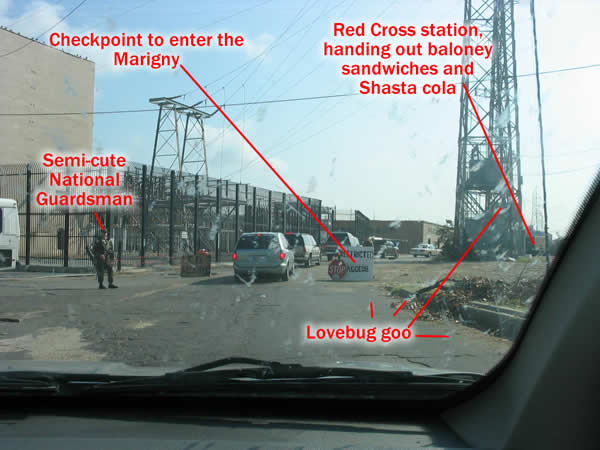
katrina--checkpoint katrina--front katrina--side

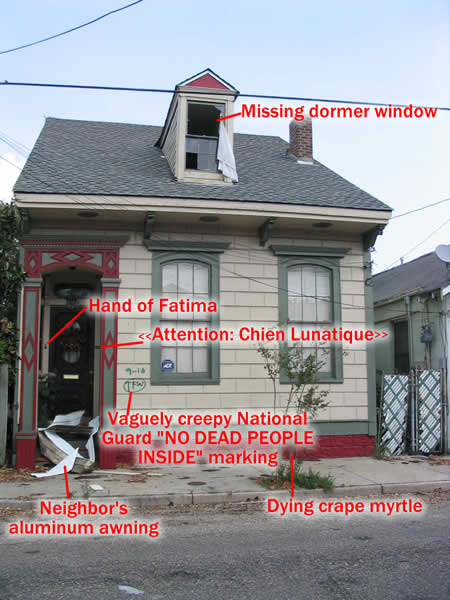
When I turn the corner, the house looks mostly as we left it. There are a couple of strips of weatherboard missing from the second floor, but they came off weeks ago when we were just starting the tropical storm alphabet, during Cindy. Most of the homes around me are fine, too. An awning torn off, a few tree limbs down. Nothing too big.

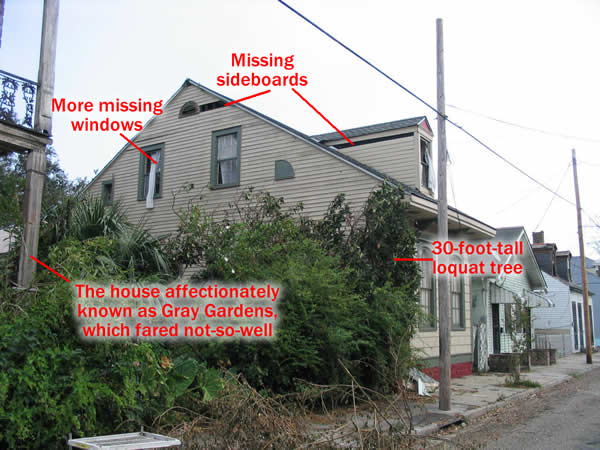
I get closer and see that our dormer window is gone. On the far side of our house, the neighbor’s 30-foot-tall loquat tree has fallen. It slid alongside our house on its way down, taking out the fence, a couple more sideboards, some windowpanes, and one complete window. The hand of Fatima is still hanging by the front door, though. So is the snooty French, “Attention: Chien Lunatique” sign. There’s a mark spraypainted on the front of the house, presumably by the National Guard. I can’t translate it entirely, but I think it means “No dead bodies inside.”

The door is heavy and swollen. That’s not surprising: midway through September, it’s still sweltering and very, very humid in New Orleans. I give the door a kick and breathe a sigh of relief: nothing’s changed. Glass on the floor from a shattered window, but otherwise, it’s okay.

There’s no smell of death in the air. I’m hopeful for Lola.

I get to the kitchen, and there are still two full bowls of cat food on the floor: the SPCA must’ve come early on and taken her away. I put my bag on the table and call around just to make sure. No answer. Great.

I open the door to the study and make my way to the back. It’s high noon, so there’s no light coming directly through the windows. It’s dark and stifling. Jonno made me a list of clothes and supplies. I just want to get them and get out.

I look around and see that there’s not much damage. Some more small trees and shrubs are down in my neighbor’s yard. A handful of my potted plants have died. I walk back to the kitchen to get my duffel bag and start packing.

Then I see her: a long, low lump stretched across a side table. I take a step toward her and call out “Lola?”, but she doesn’t respond.

The pieces quickly fall into place: during the storm, the door to the study slammed shut, trapping her in the back of the house for nearly three weeks, a few crucial feet away from bowls of food and a tap that’s still dripping. Lola’s eyes are slits, green and lifeless. I call her name again, stroke her back, but nothing.

Without thinking, I say, “I’m sorry.” I keep repeating it: “I’m sorry, I’m sorry, I’m sorry, I’m sorry.” I say it again and again as I walk back to the yard, and though the words stay the same, the inflection changes: now, I’m furious. I’m furious at the SPCA, the Humane Society, every organization I contacted one day after the storm and who’ve obviously been conducting rescues in the area. I’m furious with neighbors who could’ve checked on her. I’m furious with friends who could’ve gotten in. But of course, I’m most furious with myself. Lola is feisty and stubborn, and on the handful of occasions I’ve tried to put her in carriers, I’ve lost significant amounts of blood. In the rush of our evacuation, it was simpler to leave her behind in a well-stocked house. I never anticipated that something as simple as a tricky doorlatch, an inch-long piece of metal, would decide whether she lived or died.

I pick up a shovel and start to dig, but the ground is strangely hard. I’m sweating like a pig, maybe two or three of them. I grab a post-hole digger and try again. It’s no easier. I’m still repeating “I’m sorry, I’m sorry.” It gives me a focus, something to keep my mind occupied, something to keep me from feeling too sad and guilty just yet. I’m making no progress with the digging. It’s going to be a very shallow grave.

I hear a tiny clinking and a meager “meow.” The neighbor’s cats must’ve started using my water garden for drinking. I glance up, expecting to see the usual assortment of toms and black cats, and there’s Lola, standing in the back door, looking at me.

It’s one of those moments when I really, truly don’t believe my eyes. It’s like after someone’s died, you think you see them from the corner of your eye, but you turn your head and realize there’s no one there at all, or maybe it’s just a coat rack, or perhaps a passerby happens to have a gait similar to that of your mother or grandfather or best friend from college.

A full five seconds later, I rush over to Lola, pick her up, and bring her to the kitchen. I put her next to the running tap, but she’s not interested. Maybe the water smells contaminated to her, or maybe she’s been drinking from the toilet for the last 20 days. I place her on the ground by the food, and her mood changes. For the first time, I notice that she’s skeletal, and she’s clearly starving.

I leave her to eat while I start packing. Five minutes later, I’ve put her in the cat carrier I brought from Lafayette, and we’re out the door. I take her back to my office, where my coworkers and members of the National Guard (who have commandeered our offices, turning them into a temporary base of operations) peek in on her. I leave her in their hands and rush off to look in on other homes and pets. No luck with the outdoor cat at a friend-of-a-friend’s house. I leave her as much water as I can in an upturned trashcan lid and move on. I pass by another friend’s home and notice she’s lost a bit of her roof–nothing too big, but she’ll want to know. I take a picture and move on.

I arrive at my pal Jim’s house, which looks to be in very good shape. I see that the National Guard has come by his place, too; they spraypainted their mark on his sidewalk, which is more considerate than what they’ve done at mine, I suppose. Beside his door, there’s another mark–it says “SPCA” with a big “X” by it. Cool: they didn’t get my cat, but at least they got to Jim’s. I enter the house, just to make sure.

I call around, looking in all the hiding places I know she likes. Finally, I peek under the bed, and sure enough, there she is: curled up in a ball, hidden in the lining under the box spring. I prod her a bit, and she meows. After a bit, she slips to the floor, and I try to put her in a second carrier I’ve brought, but she’s shy and runs away. Ten minutes later, she runs behind the bathtub, and I know she’s not coming out. I open the three gallons of water sitting on the kitchen table and fill up every mixing bowl and saucepan I can find. I turn on the tap just a trickle (though his water isn’t running yet), crack open every can of cat food in the pantry, look in on her once more, lock up and go. She’s gotten by for several weeks on far less, and with power coming back on and people gradually returning, I’m hopeful she’ll do okay ’till I can get back again.

These are the high points of my day. The rest is a frustrating blur:

  • My car blows its serpentine belt and water pump shortly after dawn, just as our convoy is leaving Baton Rouge to head into the city.
  • Hours later, sometime between leaving Jim’s house and the time we begin our trek back to Baton Rouge, I misplace my keys, and I still haven’t found them.
  • I’m surrounded by drama queens and other high-strung types for the better part of the journey.
  • By the time we return to Baton Rouge and I have my car towed to Pep Boys, the store is closed; I leave my spare key and a note in the night drop, but who knows if they’ll do anything about it.
  • I have to ask my hosts–who have already put up with Jonno and I and our dogs for three weeks–to drive almost an hour to pick me up and another hour to bring me home.
  • I’m too busy to eat or drink much all day, and from about noon until the time I go to bed, I have a splitting headache.

Still, a great day.

That was yesterday, and today, of course, I’m feeling guilty. There were so many other pets I could’ve helped if I’d planned better, if I’d known where to find them. I could’ve left water for the neighbor’s cats. I heard dogs barking, and I could’ve tracked them down, left them water, too. I think my neighbor’s dogs were still in the backyard–though there wasn’t a National Guard mark on their house or the sidewalk, leading me to believe that they might be among the 10,000 or so New Orleanians who are still be holding out. (It wouldn’t surprise me: they’re of hearty Cajun stock.) Even so, I missed dozens of opportunities.

I’m starting to think I need a vacation.

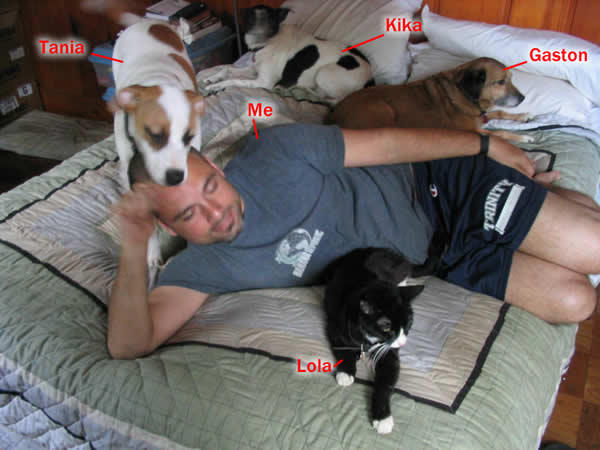
lola--rescue katrina--lolakatrina--familyportrait

Standard

MISCELLANY

  • So next week, folks in certain areas of the city will be going home. Our neighborhood hasn’t been invited back yet, presumably because portions of our ZIP code–namely, the 9th Ward and Lower 9th Ward–are still underwater. I can only hope that some of my fellow faubourgiennes are badgering City Councilwoman Jackie Clarkson by cell phone to fix the situation, ’cause her website sure as hell ain’t working.
  • For those still wondering about our cat, I have nothing to report. I hope that she was rescued by the SPCA, but when I went to the massive animal shelter set up in Gonzales, I didn’t see her. Maybe she was taken to another shelter. Maybe I didn’t see her (it’s VERY chaotic over there). Maybe she’s already escaped from the house by means of a broken window (I’m sure there were several from which to choose). I’ll know for sure tomorrow, though: I’m being taken into New Orleans via police escort. It appears that my workplace has been taken over by the National Guard, and since we don’t know how long they’ll be there, my boss and I are retrieving some essentials. Rest assured, on the way back home, I’m going to stop by my house come hell or, well, high water.
  • I’ve admitted before that I’m a low-level videogame geek. I’ve also admitted that I used to play D&D. A lot. I can say with a clear conscience, however, that I never, ever played Magic: The Gathering–although, this lil’ web project might force me to reconsider.

  • If President Bush is, as he said last night, responsible for the problems of Hurricane Katrina, I don’t think I want him to be responsible for the solutions.
Standard

An Open Letter to Andrei Codrescu

Dear Andrei:

May I call you Andrei?

Let me start by telling you how much I enjoy your work. You’re extraordinarily articulate, and your critical eye is keen–which is more than I can say of most other kids from the former Soviet Bloc. Granted, your prose sometimes waxes a bit poetic for my tastes, and your writing can become unnecessarily dense, but all-in-all, you’re a-okay in my book. We New Orleanians have been lucky to count you in our number.

However, I take some issue with your recent comments in the New York Times about our city’s “doomed” future. Specifically, you claim that New Orleans’ “great period” has come to an end as a result of the hurricane, but I have to tell you, Andrei: our “great period” was over long before you or I were born. Since before the collapse of Storyville, New Orleans has been riding on its past glories. The city has tried to grow and prosper, but we’ve been outpaced by upstart burgs like Cleveland and San Diego and–goddess forbid–Dallas. We can’t compete with the corporate communities of those cities because our educational system, not to mention our geography, have put us at a disadvantage. Even our cultural communities are average, at best. Apart from our music and culinary industries–both of which are formidable–New Orleans is no real stand-out.

In case you’re wondering, yes, I’m going somewhere with this.

The way I see it, what makes New Orleans great is its atmosphere. And I mean that in the most intangible sense possible. Tourists come to New Orleans thinking they want to taste the food and hear the music and drink the booze, but ultimately, what they walk away with is something grander and far more indescribable. And whatever that is, it’s bound up in the people. And the people will be back–maybe not the same people, maybe not your friends, but people. And they’ll be people who want to be there, who love the city’s charm and romance and je ne sais quoi and plan to keep it rolling. I mean, there’s a reason that a successful 2006 Carnival season is at the top of our city leaders’ wish-lists right now: the krewes are the city, and by ensuring that they’re alive and well, we’re ensuring that the city is alive, too.

I guess my biggest problem with what you’ve said–both here and elsewhere–is that you’re clearly a slave to nostalgia, and lemme tell you Andrei, there’s nothing I hate more than nostalgia. It’s selfish. It’s static. It’s a dead-end. You want nostalgia? Visit someplace like Savannah or Charleston: nothing but the Geritol crowd taking old-home tours for as far as the eye can see. New Orleans, however, is not nostalgic. Our city’s romance is alive because we live it every day. So while the specifics of “your city”–your friends, your hangouts, your “great period”–may be damaged or gone forever, don’t assume it’s ruined for the rest of us.

In closing, I’d like to reiterate what everyone else in the country has been saying for the past week or more: San Francisco bounced back after the Big One in 1906. New York bounced back after September the 11th. Hell, even Atlanta bounced back after being burned to the goddamn ground. And to the inhabitants of those cities, each of those tragedies looked just as insurmountable as New Orleans does right now to you and me. Luckily, our capacity for memory–fresh, vivid, blood-red memory–is very short indeed. Even now, the floodwaters are receding from the streets, New Orleans is receding from the front pages, and soon we’ll be getting on with the humdrum business of our lives. So keep writing it all down, Andrei, because in five years, you might not be able to recall how you’re feeling now. We’ll check in then, perhaps.

Thanks so much for your time, and I hope to see you soon.

Your fan,

Richard

Standard

For all those who’ve asked, our cat is still missing. I’ve gotten no word from our acquaintance who was supposed to venture into the city. I doubt he’s gone yet, and when he does, I don’t know that he’ll even have time to peek in on her.

Another botched opportunity: on Sunday, I was supposed to go to New Orleans with a very clever friend who’d figured out a way for us to get past the military patrols. I was all set, but then our wires got crossed (communication here is still a challenge), and he went without me. He was able to get to his house, but not to mine, alas.

There is some good news, though: when my friend got home, he found that a rescue team had already taken his cat. Even better, there was still a full bowl of food on the floor, meaning that the team arrived early on. So, since my friend and I put in our requests to the SPCA at about the same time, and since neither of our neighborhoods flooded, I’m hoping that Lola has already been rescued.

I have some work to do in Baton Rouge today, and afterward, I’m going to trek to Gonzales, Louisiana. That’s where they’re keeping all the rescued animals. Apparently, there’s no system to the kennels at this point. You can’t call and ask for a pet by name or location or markings or anything; you just have to go down and look for yourself. When you find a reasonable match, I think they have some rudimentary system for verifying the address where it was found. That’s what I hope, anyway.

Standard

Before August 29, I think most of us took our friends for granted. We knew where they were, we knew how to reach them. We called or emailed them when we needed them, left them alone when we didn’t.

Katrina changed all that. In scattering us to the four winds (literally), the hurricane has forced us to communicate with one another in more, I dunno, substantial ways. There’s all the I’m-so-glad-you’re-okays and the Where-are-you-livings and the Are-you-going-backs. Like the phone company, we’ve had to completely rebuild our networks–no more of this taking friends for granted stuff. That’s kinda cool, if you ask me. I would’ve prefered getting the message via an afterschool special on network television instead of being forced from my home for several months, but whatever.

The downside of that rebuilding, of course, is that my inbox is now a toxic gumbo of emails, each demanding a response. Every day, I have to let a few more sit, and they’ve really begun to pile up. So if you’ve written me in the past two weeks, rest assured, I haven’t forgotten you. I’m just avoiding you. For a bit, anyway. You’ll hear from me soon, I hope.

One other good thing to come out of all this: the name “New Orleans” has been on the lips of so many newscasters and pundits that maybe everyone in the world will finally understand that calling our city “New Or-LEENS” is just plain wrong. Unless you’re singing, of course…

Standard

So, lots of people have brought up the subject before–including moi–and I know there are many others wondering the same thing: who in their right mind is gonna live in New Orleans when all this is over?

Well, I don’t know about the “right mind” part, but I can be pretty sure that the people who go back home to stay–including yours truly–are the ones who want to be there.

Clearly, we’re going to lose folks, especially refugees who’ve found work and homes and communities elsewhere. We’ll probably lose some business people, too. And I don’t blame ’em a bit–many of ’em lost everything they had, and even those who didn’t are gonna have a long row to hoe to get things back on track. Apart from second-rate, carpetbagging contractors, no one’s gonna have an easy time of it. Only those truly dedicated to the city are likely to stick it out.

That excites me.

This could be a great opportunity–an opportunity to do some cleaning, some straightening, some reorganizing of New Orleans, a chance to fix some of its less-than-endearing flaws. Yeah, we’ll probably screw up somewhere along the way, but at least the possibility of improvement is there. That’s enough to keep me going.

Hell, if we’re lucky, we might even finally get rid of Tom freaking Benson. Ya hear me, Tommy? Your cavalier ambivalence toward New Orleans and your stupid, pandering, post-game second-lines have pissed me off long enough. Now might be a great time to pack your bags and get the hell out of Dodge. Good luck finding a sazerac in San Antonio.

Standard

Some facts: I’m an optimist. I love New Orleans. I’m keeping my car gassed up and my bags packed so I can roll right on home the second they let us back in.

Some other facts: most of New Orleans’ historic districts–the Quarter, Uptown, the Marigny–are fine, having sustained only minor damage in the hurricane. The character of the city that tourists and locals know and love won’t change. Property values in the city will drop a bit, particularly in those areas that saw minimal flooding like like Mid-City and the Treme, but the majority of the historic homes there will survive.

Today, as I drove through miles and miles of mating lovebugs on my way to dad’s place in Mississippi, I was pondering all of this, when suddenly I had a vision–a fantastic vision of New Orleans’ future. And basically the vision was this: what if New Orleans suddenly became “The Place” again? You know, the happening, moving, so-hip-it’s-not-even-on-the-radar hip place to be?

It’s within the realm of possibility. I mean, New Orleans has character and charm and romance out the yin-yang. Other culturally rich places like New York, San Francisco, Santa Fe, and even Provincetown have become impossibly expensive, pushing the young, the artists, the drag queens–in short, all the interesting people–out of town. What if New Orleans will became their new home? What would that be like?

That’s my vision.