
On the upside, I’ll have a lot more free time. Who’s up for canasta?
On the upside, I’ll have a lot more free time. Who’s up for canasta?

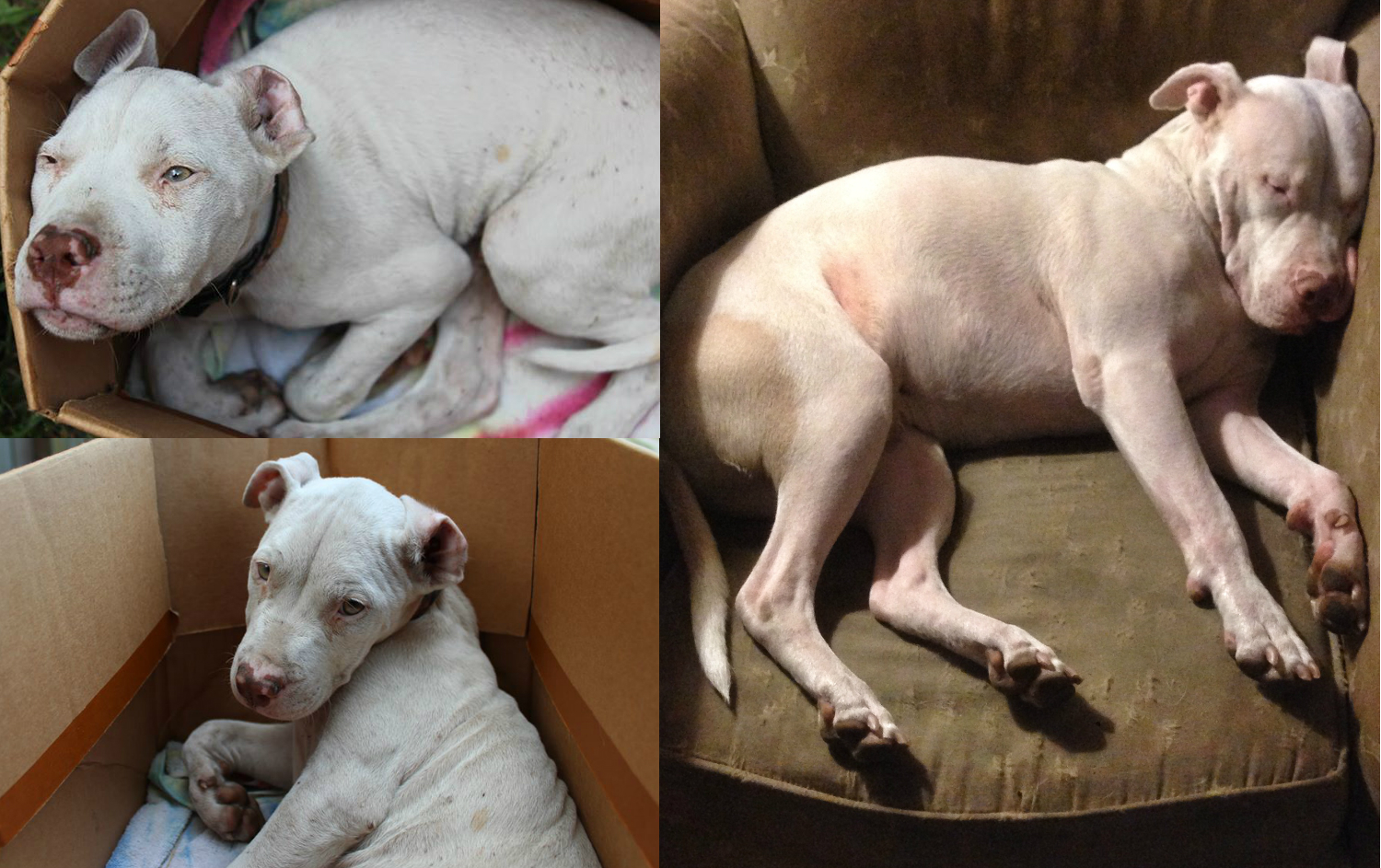
Sebastian, then and now
We’ll never know the real story of Sebastian’s first few months. All we know for certain is that he was found on the side of a road in New Orleans’ Lower Ninth Ward, unconscious, dehydrated, and debilitated by disease.
Under normal circumstances, we might guess that he escaped from someone’s back yard. But Sebastian is deaf, and that opens up the far crueler likelihood that he was abandoned.
* * * * *
Pit bulls are popular dogs in New Orleans. Breeders often use the pit bull’s unwarranted reputation for aggression to sell them for fighting and protection. It’s a reasonable guess that Sebastian was born to a breeder, and if all had gone according to plan, he might’ve spent much of his life in a cage — or worse.
When the breeder learned that Sebastian was deaf, though, the pup’s path changed. Who’s going to buy a deaf pit bull to guard her house? Who’s going to buy a deaf pit bull to fight in a ring, unable to hear his master’s commands?
And that, I think, is how Sebastian wound up on the streets. Like many handicapped animals — including humans throughout the ages — Sebastian, was rejected and left to die.
* * * * *
That’s all conjecture, though. All we know for certain is that Sebastian wasn’t willing to go down without a fight. We also know that the person who found him had heard of Ken Foster. Through his Sula Foundation, Ken treated Sebastian’s various ills, made him whole again, and then Ken began looking for folks who could provide a good home for the young pup.
When I moved to New Orleans several lifetimes ago, Cheryl became my boss and one of my closest friends. I didn’t think anything of it.
Looking back, maybe I should’ve.
I’d come from Mississippi, where there was (and still is) plenty of homophobia to go around. I knew that New Orleans had (and still has) plenty of bigots, but compared to my former home, it felt like a completely different universe. In that bizarro-world, it seemed totally normal that a bubbly, blonde, middle-aged straight woman would befriend so many gay men.
But in fact, that was kind of unusual, and as I recently learned, Cheryl took a good bit of flack for it — not just because some of her family and friends were homophobic, but also because, back then, in the early 90s, there was a lot of AIDS-phobia, too. Then, as now, AIDS was considered by many to be a gay man’s disease, so hanging out with gay men was something that “normal” people weren’t encouraged to do.

I’ve said many times that there’s an important link between being gay and being vegan. I’m still not entirely sure about the nature of that link — I need to do a little more soul-searching before I put forward a cogent theory — but I have a hunch it comes down to empathy.
In junior high and high school, I was teased relentlessly for being effeminate. As a middle-class white male — one who grew up in the American South — I’m hesitant to say that I’ve ever been “oppressed”, but I certainly know what it’s like to be an outsider.
I also know how to put myself in other peoples’ shoes. Maybe that’s some of my adoptive mother rubbing off, maybe its some of my biological uncle I inherited (he was an accomplished actor). But for whatever reason, I can see things from multiple points of view.
In other words, I have an ability to empathize, and I’m especially drawn to those on the margins, including animals.
I don’t think that’s a unique talent. In fact, I think it’s pretty common, particularly among LGBT folks who’ve grown up in the straight world (i.e. most of us). For better or worse, many don’t use it, though.
The mini-doc embedded above doesn’t dig nearly deep enough into the connection between the fight for LGBT rights and the fight for animal rights, but it scratches the surface. And maybe it shows that I’m not crazy for believing that the connection is there, too.
 sturtle [dot] com